6 Ways to Ensure Women’s Equity in the Workplace

by Claire Hastwell, Great Place to Work® USA, 08 March 2022

From trainings and promotions to internal communications and ERGs, managers can foster more fairness for women in the workplace. 

Gender bias and discrimination are unfortunately still a major issue in the workplace across the country.

When women aren’t appointed to leadership positions, decisions for women are being made by executives who may not fully understand the scope of women’s issues, such as access to equal opportunity, harassment, patriarchy, the debate over reproductive rights, the gender pay gap, and other lesser known issues.

In the year 2022, women are still paid less compared to men. Research shows that even after 15 years the gender gap in pay has remained relatively constant. In 2020, women earned $0.82 for every $1 earned by men—this gap is even larger for women of color.

This is why Katie Barnes, CHRO at BHG, has made it her mission to use her leadership position to make the workplace more equitable for women.

Katie oversees the strategy and direction of BHG’s People Development (PD) department, leading various programs such as Talent Acquisition, Talent Management, Employee Experience, and Compensation.

Katie has been with BHG for nine years and in that time built an inclusive workplace for women. As a result, BHG not only incorporates webinars and workshops geared toward women leaders, but also ensures any decision-making process includes diverse perspectives.

BHG’s push towards diversity is one of the reasons its leadership team is over 40% women, compared to the national average of 21%.

In light of Women’s History Month, Katie has shared six tips on how leaders and managers can ensure women can be lead, be heard and succeed equally within their organizations.

1. SCHEDULING MANDATORY DIVERSITY AND INCLUSION TRAINING FOR PEOPLE LEADERS

As part of its employee experience program, BHG offers numerous webinars and courses – ranging from financial wellness to meditation and work/life balance. Management and leaders are also required to take inclusivity courses that teach them how to cultivate a voice that empowers all employees.

While inclusivity training videos are common, it is vital that you find videos and platforms, such as LinkedIn Learning, that can speak to the culture, tone and issues your own organization is facing.

2. PARTNER WITH YOUR COMPENSATION TEAM TO ENSURE YOUR PROMOTION STRATEGY IS FAIR AND TO BRIDGE THE GENDER PAY GAP

A significant role that the people development or human resources team can play in an organization is being the voice that the employees simply need. Many companies can be so laser focused on the bottom line that some decisions can unintentionally harm morale or come across as unfair.

“Companies can be so laser focused on the bottom line that some decisions can unintentionally harm morale or come across as unfair.”

That is why each quarter BHG sits with their compensation team to confirm that all demographics are being paid fairly and to stay ahead of any red flags in pay or other forms of unfairness that may negatively impact employees.  

Understanding employee needs and the issues they face also goes beyond pay; sometimes they face roadblocks that don’t show up in compensation reports.

That is why areas such as internal communications, or even having a close-knit relationship with department leaders is vital. This ensures messages of inclusion aren’t only being relayed but also observed.

3. BE AN EXPERT WHEN IT COMES TO YOUR ORGANIZATION’S BENEFITS

HR is a great resource for divulging knowledge on your company’s benefits; however, as a people leader, you can also be an advocate for your team and encourage them to use benefits that best suit their individual needs.

BHG offers all employees two sessions with a licensed therapist per month, as well as life coaching services. These coaching benefits rely on regular promotion by people leaders and are proving especially beneficial for working mothers.

When planning out benefits, it’s important to be an expert not only on policies, but on what your team needs. Much like you know what your family needs to foster a healthy home life, it is the role of the HR team to know what benefits employees need to foster a healthy work life.

Be an advocate not only in recommending your benefits to certain employees who need them, but also an advocate to the company to add benefits that benefit women, mothers and any other underserved demographic.

A practical way that BHG approaches this goal is using twice annual employee engagement surveys to identify areas of need and then adjust both benefits and employee experience programs based on the results.

4. BE MINDFUL OF RECOGNIZING YOUR TEAM MEMBERS EQUALLY

If your organization offers regular opportunities for you to recognize your team, take time to make sure you are being intentional in your recognition efforts, especially in roles primarily dominated by males.

As a FinTech, many of BHG’s roles are in the technology space; however, in their monthly award ceremonies, BHG encourage people leaders to avoid nominating the same employees more than once during the calendar year so that they can recognize a larger number of employees.

Use recognition ceremonies, announcements, and newsletters to shine light on a number of employees, and take stock of any trends that may be marginalizing certain groups or individuals. Also use these announcements as times to remind them of unique benefits or workshops.

5. AVOID MAKING ASSUMPTIONS

Recognizing unconscious biases is one of the first steps leaders can take in promoting equity among their teams. Instead of making sweeping assumptions about the needs of women in the workplace, take the time to get to know your team members individually, including their strengths, passions, or motivators.

One way to avoid making assumptions about the needs of women in your workplace is to implement one-on-one sessions throughout the year with team leaders.

BHG ensures their people development team meets with leaders and managers at least twice a month to discuss their needs, as well as the needs of their teams. This feedback allows managers to hear about challenges first-hand while also fostering an environment of communications and understanding.

It’s very important that your workplace promotes an open space for all employees to speak up on issues affecting them. While we usually think of internal communications only existing from the C-suite down, all employees play a role in proactive and beneficial communications.

It is important to ensure that all employees, especially those who oversee a team, use inclusive language, fair and balanced communication styles and have open conversations to combat any problematic assumptions.

“Getting to know employees on a deeper level is key to creating an inclusive and open environment.”

Understanding and getting to know employees on a deeper level is key to creating an inclusive and open environment.

6. CREATE A SAFE SPACE FOR YOUR EMPLOYEES TO BE HEARD AND FEEL SEEN

Employee resource groups (ERGs) are a great way for people leaders to create an inclusive environment for their team members. BHG developed a “Women in Tech” employee resource group that allows female employees in technology roles to connect, network, and learn from one another.

The next employee resource group in the works is a group dedicated for working parents to come together, which is even more necessary since transitioning to remote work.

ERGs do not have to be formal or complex. An ERG could simply be a few leaders in a Slack or Teams chat, or a scheduled Zoom lunch to discuss a book, topic or even host a guest speaker.

Encouraging curiosity, creativity and open communication isn’t only great for fostering innovation, but also for fostering morale and true bonds for your team.

These are just a few of the ways that BHG has ensured inclusivity with the help of their people development department. But there is no shortage of ways to encourage open dialogue -through open dialogue, creative thinking and buy-in from your company, you can also begin allowing all voices have a place at the table at your company, too.

Companies Gen Z Want to Work For – And Why

by Claire Hastwell, Great Place to Work® US

Gen Z may just be an emerging generation in the workforce, but employers in-the-know recognize it’s a demographic they need to appeal to now.

Lumping all “young people” into one category is unwise. It will hurt your hiring, your employee engagement and – as we’ve seen in the past two years – the way employees measure how their managers show up in a crisis.

Through our extensive research of the Best Workplaces™ in the U.S., we’ve been able to extrapolate the data to understand where Gen Z are now, and where they’re going.

Gathering over 32,000 Gen Z employee survey responses from more than 3,500 companies across the U.S., we’ve identified the workplaces that are getting it right when it comes to attracting and retaining Gen Z.

COMPANIES GEN Z WANTS TO WORK FOR

ALTAR’D STATE

Altar’d State is a women’s fashion brand, with 121 boutiques across the USA. Over a third of its employees are Gen Z, with 94% of them ranking it a great place to work.

Employees at Altar’d State feel a strong sense of purpose at work every day, in part thanks to their “Mission Mondays.” On Mondays, 10% of their net proceeds go to local charities in their communities.

In their Trust Index™ survey, many Gen Z employees at Altar’d State expressed how much meaning they felt at work (one of the key things Gen Z want from employers):

I always tell people that I don’t just work retail, because our giveback mission is what truly stands out. I’ve worked at other retailers prior to Altar’d State and I’ve never held the pride I do in sharing Altar’d States mission. Although we are a large company having the opportunity to create local relationships with other organizations is something that is truly unique. – Gen Z employee at Altar’d State.

TECHSTYLE FASHION GROUP

Global fashion retailer TechStyle uses data science for personalized, membership-based e-commerce. It’s also a company that 93% of its Gen Z employees say is a great place to work.

Diversity, equity and inclusion (DEI) are more than just words on a mission statement at TechStyle. The company measures employees’ feelings of inclusion and belonging in their survey and the results are impressive.

Ninety-five of employees believe people are treated fairly regardless of their sexual orientation, and 92% say that people of all cultures and backgrounds are valued at the company. This is good news for any company wanting to recruit the next gen, since Gen Z is the most diverse employee group yet.

I think the inclusive culture of this company is unique to most, I feel that many companies preach this message, but don’t practice it. Fabletics does a great job of doing both. Also, my managers have done an incredible job of creating a team environment in the store where everyone is welcome and feels valued. This team is not just a group of employees, but rather a family. It’s unusual to find that in a retail store, and I have to credit that to our managers and team leads. – 
Gen Z employee at Fabletics, part of TechStyle Fashion Group.

WEGMANS FOOD MARKETS, INC.

With a quarter of its survey respondents within Gen Z, supermarket chain Wegmans scores high — 93% of them say it’s a great place to work. Things like daily team huddles and employee appreciation budgets are just a few ways the company supports its staff.

Wegmans also offers an employee scholarship program, which continued even amidst the pandemic, with 1,842 new scholarship recipients in 2020. After college, some of their scholarship winners move into a new field, but many Wegmans grads pursue a career within the organization.

I’ve been given the opportunity to train in any department I showed interest in. I know that I will continue to be asked if I want to participate in more learning opportunities in the future. Management is stable but constantly changing due to how many people are given opportunities to train. We were consistently shown appreciation throughout the pandemic through coupons for free PPE, free meals, and extra flexibility with scheduling. – Gen Z employee at Wegmans.

WESLEY ENHANCED LIVING

Aging services company Wesley Enhanced Living prides itself on creating a sense of community and meaningful connections, and a sense camaraderie between employees and residents. It’s clearly succeeding, with 92% of its Gen Z employees ranking it as a great place to work.

Eighty-five of Gen Z employees feel their work has special meaning. In their survey, many Gen Z employees compliment the caring management as well as the social interaction with residents – three core drivers of happiness at work for Gen Z

You feel very welcomed by others. The managers are very understanding. This company makes it a great place to work compared to other places.– Gen Z employee at Wesley Enhanced Living.

MATHNASIUM – KV

Mathnasium is a math learning center dedicated to teaching children math in a way that makes sense to them and goes beyond traditional tutoring. Nearly 60% of its employees are Gen Z, with 90% of them saying it’s a great place to work.

Mathnasium stand out for their equitable treatment of people from diverse backgrounds, with 99% of employees believing people are treated fairly regardless of their race. Many employees also mentioned how “welcomed” they felt when joining the company – another key driver of Gen Z employee experience.

The welcoming nature and attention to making all the students and employees feel as comfortable as possible are what set this company apart from many other places to work. – Latinx Gen Z employee at Mathnasium.  

WIRELESSVISION

With locations in 30 states, WirelessVision is the largest T-Mobile retailer in the U.S. It’s also a place that prides itself on its company values: passion for its people, being best in class, staying hungry while loving the hustle, being honest and humble, and working hard while playing hard. Among its Gen Z staff, 90% said they think it’s a great place to work.

When asked what makes the company a great place to work, some employees mentioned feeling valued and how management lives up to company values.

[What’s special is ] recognition that’s given to the people who have earned it. I love the core values and that the company lives by them. Makes me feel appreciated. – Gen Z employee at WirelessVision.

QUIKTRIP

Self-described as “a fast-paced, happy bunch,” convenience store company QuikTrip certainly has happy employees. With one-fifth of its employees identifying as Gen Z, 90% of them said it’s a great place to work.

QuikTrip truly cares about their employees. I feel confident that my company would make the right decisions for myself and my co-workers in any situation, instead of doing what is best for the higher-ups. – Gen Z employee at QuikTrip

THE CHEESECAKE FACTORY

Like most restaurant chains, The Cheesecake Factory was hit particularly hard during the pandemic. But rather than let employees go, the company furloughed staff, so that they could keep their health benefits. They also reduced the hourly requirement for working staff to receive benefits and donated food and household essentials to staff stuck at home.

Nearly one-fifth of The Cheesecake Factory’s employees are Gen Z, with 89% of them ranking it as a great place to work. It’s clear that mental health is taken seriously at the company:

This company is accommodating to its staff and never questions you if you need time off for personal reasons. They check in to make sure your personal life is going well, as well as check in to make sure there isn’t anything they can be doing better when it comes to assisting their employees in the workplace. After discovering I had a serious illness that would require time to figure out proper treatment, my management gave me the time off I needed to get things squared away with my doctors without making me feel guilty for doing so. In fact, because they were so accommodating it made me want to work harder for the Cheesecake Factory in return. – Gen Z employee at The Cheesecake Factory.

NUGGET MARKET, INC.

At family-owned, Sacramento-based grocery chain Nugget Market, 96% of Gen Z employees say it’s a great place to work. The company prioritizes training and development for store managers through “Nugget High” and offers a 10% discount to all employees.

The company is also working to foster positive relationships between the community and police, through their “Coffee with a Cop” events, hosted in their cafes. The events allow people in the community to meet with local officers.

Mistakes are seen as opportunities for growth, not points of criticism. This applies whether it is a guest complaint or feedback from a manager. I never feel like I am being punished, rather I am given the chance to do better next time. This creates a positive and encouraging work environment, as well as strengthens my relationship with the managerial team. – Gen Z employee at Nugget Market.

What Gen Z Wants from Employers

by Claire Hastwell, Great Place to Work® US

Gen Z is coming to your workplace.

The generation born between 1997 and 2012 may be just entering the workforce, but smart employers are already thinking about how their company culture can attract and retain Gen Z.

According to the Bureau of Labor Statistics, 16- to 24-year-olds made up 11.6% of the workforce in 2020, primarily in the industries of retail, hospitality, and senior living — all of which were hardest hit by the pandemic and lockdowns. Because of this, this generation has a unique perspective as new workers under extraordinary circumstances.

In our research of workplaces around the country, we’ve collected over 32,000 Gen Z employee responses from over 350 companies. Here’s what Gen Z says they want from employers in 2021 and beyond.

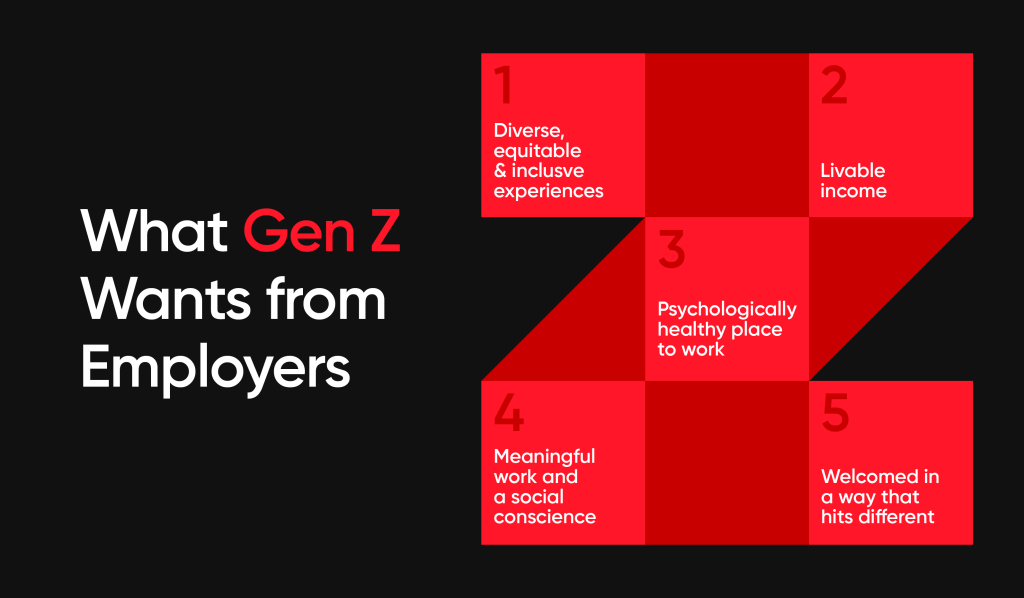
WHAT GEN Z WANTS FROM EMPLOYERS

1. DIVERSE AND INCLUSIVE WORKPLACE

Gen Z is tracking to be the most diverse workforce yet, with our data showing 47% of Gen Z employees identifying as

BIPOC By comparison, 39% of Millennial workers we surveyed identified as PoC, versus 34% of Gen X and only 25% of Boomers.

Pew Research Center points to changing immigration patterns —immigration to the U.S. peaked in 2005 and then declined — that have shaped Gen Z’s demographics. There are fewer Gen Zs than Millennials who are foreign-born, but a higher number who were born in the U.S. to immigrant parents.

As Gen Z grows into the workforce, employers must learn how to best manage a diverse team and get serious about DEIB initiatives. This includes:

  • Ensuring a diverse slate of candidates to secure the best talent
  • Training other employees (particularly older generations) on DEIB, and
  • Ensuring there’s representation across the leadership team.
2. LIVABLE PAY

Pay was the number one topic Gen Z employees commented on in our research, with calls for better minimum wage and increased hourly pay. Only 69% of Gen Z employees said they feel they’re paid fairly, which is 7 points below other generations.

Because of their young age and career stage, most Gen Z employees are working in industries such as retail and hospitality, which tend to be lower-paying or reliant on tips. These were also the industries most impacted by lockdowns, leaving Gen Z workers bearing the brunt of COVID-19 furloughs and closures.

According to payroll company ADP, Gen Z was hardest hit by job losses in 2020, losing some 11% of their jobs, well above the national average (6.7%) and impacts to other age groups.

With the current hiring crunch slamming retail and hospitality in particular, employers wanting to attract Gen Z talent will need to offer fair pay and earn the trust of a generation uniquely hit by the crisis.

3. MENTALLY HEALTHY AND SAFE PLACE TO WORK

Some of the widest gaps between Gen Z and other generations are around feeling their workplaces are psychologically and emotionally healthy.

In our research, Gen Z employees showed a 7-point difference on statements measuring:

  • Psychologically and emotionally healthy workplace environment
  • Ability to take time off from work when necessary

The American Psychological Association has identified Gen Z as the most stressed generation, attributed to growing up while the world has faced severe global challenges like gun violence, climate change, political instability, racial reckoning and a pandemic.

Great employers will need to ensure Gen Z feels emotionally supported in the workplace, through things like regular check-ins and encouragement to practice self-care (although, to be clear, that’s something all generations could benefit from after the past year).

4. SPECIAL MEANING

Finding purpose and special meaning is something that has typically been associated with the Millennial generation. But our research found the meaning deficit is even more acute for Gen Z, who scored their employers:

  • 8-points lower than other generations on how much their work has special meaning
  • 7-point lower than other generations on how much they feel they make a difference at work

Grocery chain Wegmans is one example of a company that’s giving employees a voice, and 93% of Gen Z respondents at the company ranked it as a great place to work.

Wegmans management frequently seeks out ideas from the front-line workers who interact with customers the most, and all staff are invited to make suggestions and ask questions through “Ask Jack,” the company’s SVP of operations, Jack DePeters.

Since launching in 2002, Jack has responded to over 16,000 employee comments, with 68% of employees choosing to identify themselves by name rather than submit anonymously.

5. WARM WELCOME

Gen Z is still young. Many of them are just getting started in the workforce. A warm and thoughtful welcome can go a long way when you’re onboarding new grads and first-time employees.

With many employers switching to remote or hybrid workplaces post-pandemic, this can present a challenge — the usual practices of showing a new hire around the office or taking them out for lunch may no longer be an option for some workplaces.

But companies like YNAB are making it work. The software firm sends out welcome packages in the mail, timing them to arrive on an employee’s first day. The packages include YNAB swag, a booklet about the company’s vision and mission, personalized welcome messages from the team and a dinner gift card for the employee to celebrate their new job.

For someone new to the working world, efforts like this can go a long way to keeping them enthusiastic and engaged.

For years, Millennials have been the talked-about generation as brands have worked to woo them, either as customers or as employees (or both). But now that the next generation is on the workplace doorstep, employers need to start thinking now about how they’re going to attract the next gen of talent.